
Marcus Hinschberger · Instructor paper #01
A student has been sitting for an hour. Another is too embarrassed to join a game. A third starts moving but gives up when the activity changes. What would a healthier classroom routine give each of them a chance to do?
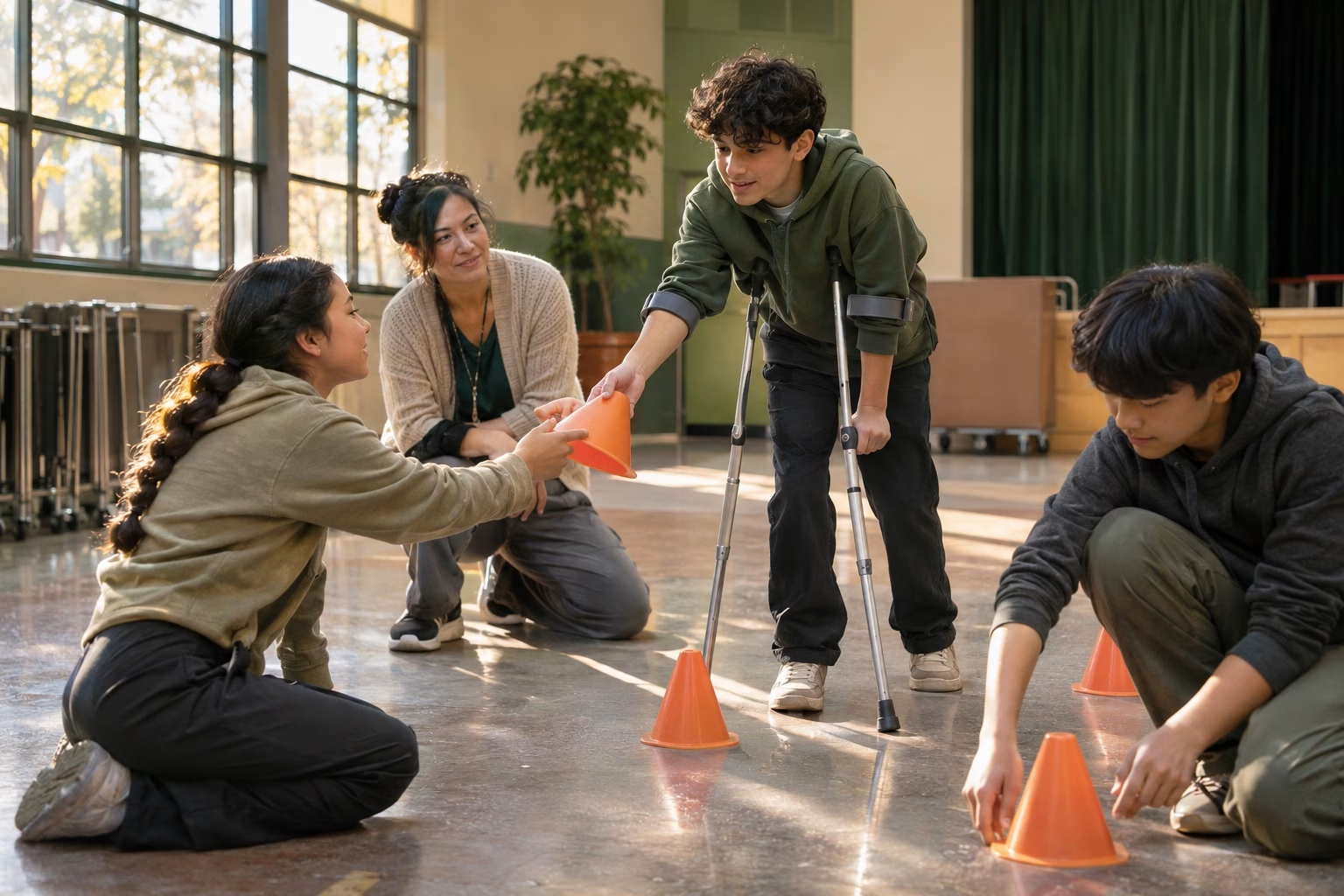
Give one activity three goals
Start with the body. Choose an activity students can do seated or standing, with room to practice balance, coordination, or stamina at their own level. Give the mind a job too. A student might attend to a signal, remember a sequence, or adjust when the group changes pace. Then make space for what I call spirit: purpose, courage, and the willingness to try again.
For example, a group can practice a short sequence together. Students decide which version works for them, take turns leading, and finish by naming one thing they improved. The teacher can see who’s participating, who can refocus after a mistake, and whose next step needs support.
Ask what changed
If I were starting in a school, I’d ask teachers which two signs of progress would be worth looking for. Participation and the ability to rejoin after a setback are a practical pair. An inclusive routine can give a student a way into the group and give the teacher something observable to build on.
I learned to think about health this way while teaching traditional Karate-Do. It is one part of a four-quadrant framework I developed for my instructor paper. How would you adapt this activity for your students?
Read the four-quadrant framework for educators
Download the original instructor paper, “What Is Karate?” (PDF)